Thursday, May 20, 2010

Do slugs drink beer?

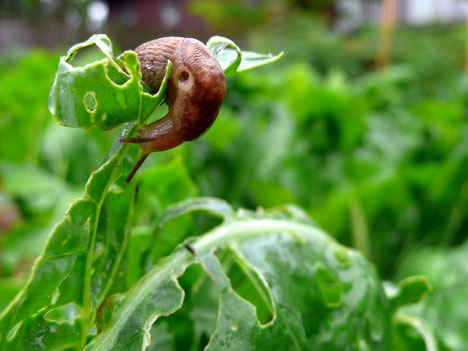
Remember when we planted no till potatoes and I talked about the inevitability of slugs since we used so much straw? Well, the good news is that those potatoes are starting to poke through the straw (!!), but the bad news is that there are many slugs just waiting to munch on those unsuspecting tubers.

 This is a picture of a very happy slug...taken by a very unhappy gardener. 

I have already found slug damage on the swiss chard, which made me think it was time for a beer. Not for me...for the slugs. Placing wide mouth, shallow bowls with beer around the garden can keep slugs away. They are attracted by the beer and slime their way into the bowl, where they drown. I will check first thing in the morning to see how many slugs were trapped over night. I will have to keep the beer fresh, at least while the plants are small and susceptible. Check back for updates on the slug eradication efforts!

**Disclaimer: No craft micro-brew was injured on this mission.

Tuesday, May 11, 2010

Carrots love Tomatoes

Especially "Angela's 'Nelson' Carrots".

(Photo courtesy of Johnny's Select Seeds)

I am planting 4 varieties of carrots this year: Mokum and Nelson are classic orange carrots. And, Purple Haze and Deep Purple are dark purple carrots. I am especially excited for the purple carrots, although I love talking about "My Nelson Carrots". I have already sown 2 succession plantings and am not happy with the spotty germination. I even had row cover over them to aid in germination and lightly watered on most days. Someday I will try the burlap method of germinating carrots. Right after seeding, you lay burlap over the bed. The burlap allows light and water through, at the same time as keeping soil moist and soft for those tiny seeds. Once the carrots germinate, pull back the burlap, taking larger weeds with it, leaving behind beautiful rows of carrots. This cuts down on the weeding too!
I decided, today, to plant more carrots in the tomato beds. I sowed 2 rows on either side of the tomatoes. This may result in way more carrots than I can harvest, wash, sell or eat.

Tuesday, May 4, 2010

Red Skies at Night, Sailors Delight; Red Skies at Morning, Sailors Take Warning

Or so goes the way I learned it.

The last two mornings I woke up at dawn to see a very pretty pink sky and I knew we were in for some crazy Central NY weather. I was not disappointed. Yesterday winds and a hard, quick rain. Today hail. I am not complaining about this weather, as I love when I don't have to water thirsty seeds. Yesterday, I was able to get radish, beet, turnip, carrot, greens, and sunflower seeds into the ground before being caught in the rain. Already wet, I decided to throw down some clover seed into some beds that I won't plant for a while. Not a typical cover crop, at least alone, but I plan to use it as a "living mulch" under late planted brassicas (broccoli, cabbage, etc) and late planted tomatoes. The clover quickly shades out other weeds and grows low to the ground providing moisture retention. It may need mowing before I transplant the brassicas, but it recovers quickly and clover has been shown to reduce populations of the cabbage looper, aphids, and flea beetle. One drawback is the increase in slugs. But I have some old beer for them (more on that another time).

Things are moving quickly now and we are about 1 month away from the first market!

Tuesday, April 27, 2010

No till potatoes

This past weekend we planted potatoes, all 40lbs of Banana Fingerling, Adirondack Red, Red Gold and All Blue. Thanks to my parents who came to help out to make easy work of these no-till potatoes. Conventionally, potatoes are planted into a furrow 3-4" deep in freshly cultivated soil. As the plants germinate and grow, the soil is hilled around the base of the plant. Hilling allows the growing tubers to remain in moist, dark conditions that increase yield and prevent"greening". Preparing soil for potatoes not only is time consuming but also disturbs soil structures and exposes weed seeds in the lower layers of the soil to the light they need for germination. In northern climates, especially, Spring is characteristically wet and cold, which can prevent timely preparation of these potato beds. There is also little time for Spring growth of cover crops needed for soil fertility and weed suppression.
One way to work with the land, and not against it, is to plant no-till potatoes. I planted a dense cover crop of rye, vetch and crimson clover in the late summer with enough time for it to establish. However, the real growth didn't come on until the early Spring . To prepare for planting, I mowed down the cover crop which resulted in a nice surface mulch to retain soil moisture and suppress weeds. The potatoes pieces were then laid out on the surface and covered with about 6"-12" of straw. That's it! As the potato plants grow, I will mulch with straw 2-3 more times until there is a dense cover of straw protecting the future potato crop.

After harvest, I should have a weed free bed ready to plant a late cover crop or even the fall garlic. There will still be decomposing straw cover, which would benefit the garlic planting very well.

Tuesday, April 13, 2010

Compost

Farmers love this stuff.
Everyone should love this stuff. Mix it with your house plants, load it into your garden, spread it on your lawns...better yet turn that lawn into a garden and add compost.

I got a load of compost delivered today from Toad Hollow Farm, which is right down the road from my farm site. It is dark, rich, and moist...and has a great smell to it. Compost not only adds organic matter and nutrients to a soil, but it can break up clay soils and improve water holding properties to sandy soil by improving a soil's tilth. It also feeds the microorganisms that live in our soil and without them the soil would be dead.

I will be mixing the compost into the beds this week one wheel barrel at a time. I would have preferred to spread it before tilling, but I needed to till when the ground was dry enough after a rain but not hardened from too dry weather. I had a pretty small window when I thought the conditions would be right, and I did not have time to get the compost.

I hope to be able to generate enough compost on my farm one day, that I will not have to rely on off site fertility. It is important to close the circle of nutrient transfer. While I know there are some things that the soil and farm will need that it cannot produce, composted manure or composted garden/food waste is one way of returning nutrients to the very soil they came from.

Sunday, April 4, 2010

Till and no-till

With the unseasonably hot (and windy) weather we have been experiencing, I was able to till a few of the garden beds by hand this week. I planted some late summer/fall cover crops on these beds and want to turn this growth into the soil for added organic matter. Hand tilling usually starts with this "beast" the broadfork:

The curved tines allow an easy rocking motion to aerate and loosen compacted soil. It's great for spaces that will be grown intensively, as it does not disturb the soil layers and structures, and allows earthworms and microbes to do their job in the soil. Although heavy, the tiling motion is effortless.

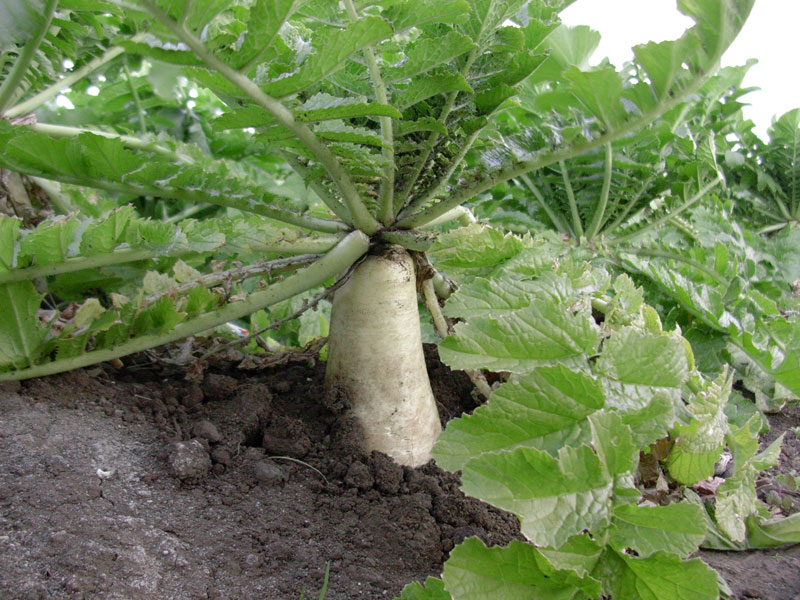
Hand tilling can be fun, and quite a workout, but I am always interested in learning ways to "no-till" my garden beds. You can find a number of experiments for no-till but one of the most interesting approaches is using the daikon radish or more appropriately dubbed the "tillage" radish . I first experimented with these radishes on a project with Charlie White, a student of Dr. Ray Weil, at the University of Maryland. Dr. Weil has been working with a team of researchers and farmers to study the benefits of the tillage radish since 2001. The objective of their project was to study weed suppression during and after tillage radish cover crops were grown. However, the results of their study proved more beneficial.

Here's how it works: tillage radishes, planted in the fall as a cover crop, have been shown to benefit soil fertility, reduce soil compaction, and limit weed growth. The radishes grow a very long taproot, up to 2" diameter and 18" long! This long root drills holes in the soil and opens up spaces for plant roots, oxygen, and earthworms to move freely. The radish, then fully mature by winter, dies off from the frost leaving its leafy green matter as a residue on the soil surface. This mulch not only add nutrients to the soil, but also protects the soil surface from erosion during the winter and suppresses early Spring weeds. Studies show the radish cover crop can capture 150-200lbs of nitrogen per acre, and make it available in Spring for the first planting of early crops.

Another benefit I have found of the radish cover crop is the soft soil it leaves behind in the Spring. Raking back the decomposed leaf matter, I found soil that was loose, aerated, and ready to be seeded or transplanted right into. No need to till by hand or large, soil compacting tractors. I love the idea of preparing the fine seedbeds with plants instead of steel. Plus, a few "stolen" radishes make a delicious fall snack!
Wednesday, March 24, 2010

Seed starting explained

I thought I would post some pictures of my seed starting set up. I am using the laundry room in my parents house for a crowded and uncomfortable seed starting space.  I fill the seed trays with growing mix, press thousands of seeds into the soil, and balance them precariously on a washing machine until I get them into their warm home. I have converted a spare bedroom into a growing room for the plants to get them started during the cold, gray Syracuse Spring. Here are some fluorescent lights hanging from shelves, about 1-2 inches above the little seedlings.


 With plastic covering the south facing window, the room stays between 70-90 degrees. A cozy little spot for the newest additions to Daily Harvest Farm. Although this is working, I cringe when I see these little seedlings stretch for the light given off by the fluorescent when all they really want is sunlight. They would be much bigger and a lot more healthier if grown from sunlight. I also think these plants grown under unnatural light and protected from the wind do not become mature plants that are as strong or abundant than they would be if grown outside. However, this is Central New York, so we will keep starting our seeds until the sun shines bright and warm.


As soon as the weather turn a bit warmer, to stay above freezing at night, we will transfer the seedlings into our small propagation greenhouse. We built this greenhouse from PVC pipe and covered it with 4mil greenhouse film for maximum light penetration. On a sunny day, temperatures can jump up to 100 degrees very quickly inside, but without supplemental heating it can reach freezing overnight. For the health and vigor of the pants, I will be relieved once they can be in the greenhouse full time. But I will act like a hovering parent (keeping my eye on the temperature, opening the vents when the sun is out, closing the vents if it hides behind a cloud) to assure everything is perfect. It's a delicate dance during the Spring, and such a nice, quiet warm up to summer.